
Berberine - the good, the bad, the ugly
If it weren't for modern GLP-1 drugs, you'd never have heard of berberine. It has been known for a long time, but it was used much like a natural antibiotic before those were even invented - for stomach infections, diarrhea, parasites, and also skin and eye infections.
Its potential effect, similar to semaglutides (medications) on the GLP-1 hormone, was noticed by accident and is now being studied more and more.
But the supplement industry has already grabbed it like a hot cake, and here we need to talk about the good, the bad, and the ugly, because some are simply cheating - though not in the way it seems at first glance.
What is berberine?
Berberine is a plant-derived alkaloid found in various plants, the most familiar to us being barberry, Oregon grape, goldenseal and others.
But it is nothing new - berberine has been used for thousands of years in traditional Chinese and Ayurvedic medicine to treat various illnesses and inflammation. And even today, as a supplement, it has been known for a while.
What does berberine do?
- Regulates blood sugar levels. I know that blood sugar is currently yet another hobby horse in the health industry, but for a healthy person this will not change anything. Studies show that berberine can be a help for diabetic patients.
- Can slightly lower bad cholesterol and total cholesterol levels, as well as triglyceride levels - so it positively affects the lipid profile overall.
- Alters the gut microbiome - this can be positive, but it can also disrupt the microbiome's diversity, which is important.
- It also has antioxidant and anti-inflammatory properties.
- And animal studies suggest that it may increase GLP-1 hormone levels.
But the main reason berberine is so popular right now and why it is compared to Ozempic, Wegovy and similar drugs is precisely this last point - the least studied and the least significant.
GLP-1 is a hormone that, after eating, helps regulate blood sugar, slows gastric emptying and reduces appetite, and this is the main mechanism by which Ozempic and other semaglutides work. But berberine's effect on it is poorly studied and insignificant.
Moreover, data on its effect on humans is scarce and inconsistent.
What do studies say about berberine and weight loss?
When it comes to semaglutides, the study results are impressive - on average 12-15% of body weight lost over a year. In some cases even 20%. That means a person who weighs 100 kg could lose about 12-15 kg a year, without drastic diets, but with improved nutrition, physical activity and the effect of semaglutides on appetite, gastric emptying and satiety signals.
By contrast, berberine studies show far more insignificant results - people taking berberine can at best expect ~1-2 kg of loss over 12 weeks. To achieve such results, usually up to 1500 mg of berberine (HCL) per day was used.
To understand this difference: with Ozempic and similar medications almost everyone will lose weight effortlessly. With berberine maybe something will drop, but if you change nothing at all in your diet and lifestyle, you are more likely to see no effect. And to compare further - with practically any diet, even a very conservative one, you can achieve a much bigger effect than with berberine.
So with these medications there will also be a result (at least short-term) without doing anything extra; with berberine - most likely not, even though it promises almost the same effect.
Or the comparison is like putting out a fire with a small green plastic water pistol versus a firefighter's hose. Both supposedly do the same thing.
Supposedly.
Studies also show that berberine's effect is not in directly suppressing appetite, but rather in a positive effect on insulin function, glucose levels and the lipid profile, which can indirectly promote weight loss.
But importantly, most berberine studies have been done on people with health problems - diabetes, metabolic syndrome, elevated cholesterol and triglyceride levels and even PCOS - these people have something to improve. That is why an effect on weight is observed, which is indirect.
Meanwhile, studies on healthy people who simply want to lose weight are practically nonexistent, or they are short and with a small number of participants.
What does the supplement industry do?
Its biggest “victory” is to find a natural alternative to something truly good and effective from BIG PHARMA and then sell it with the same dream - easy, fast weight loss, but “from nature.” And much cheaper and more accessible.
How nice and noble, right?
And berberine is the best candidate for this, because it has shown some effect on weight loss in studies. But is the effect as big as the ads and influencers say?
I remind you that the studies are still very weak and unconvincing, but there is one big and important nuance - the studies (even these weak ones) were done with at least 500 up to 1500 mg in HCL form, i.e. berberine hydrochloride.
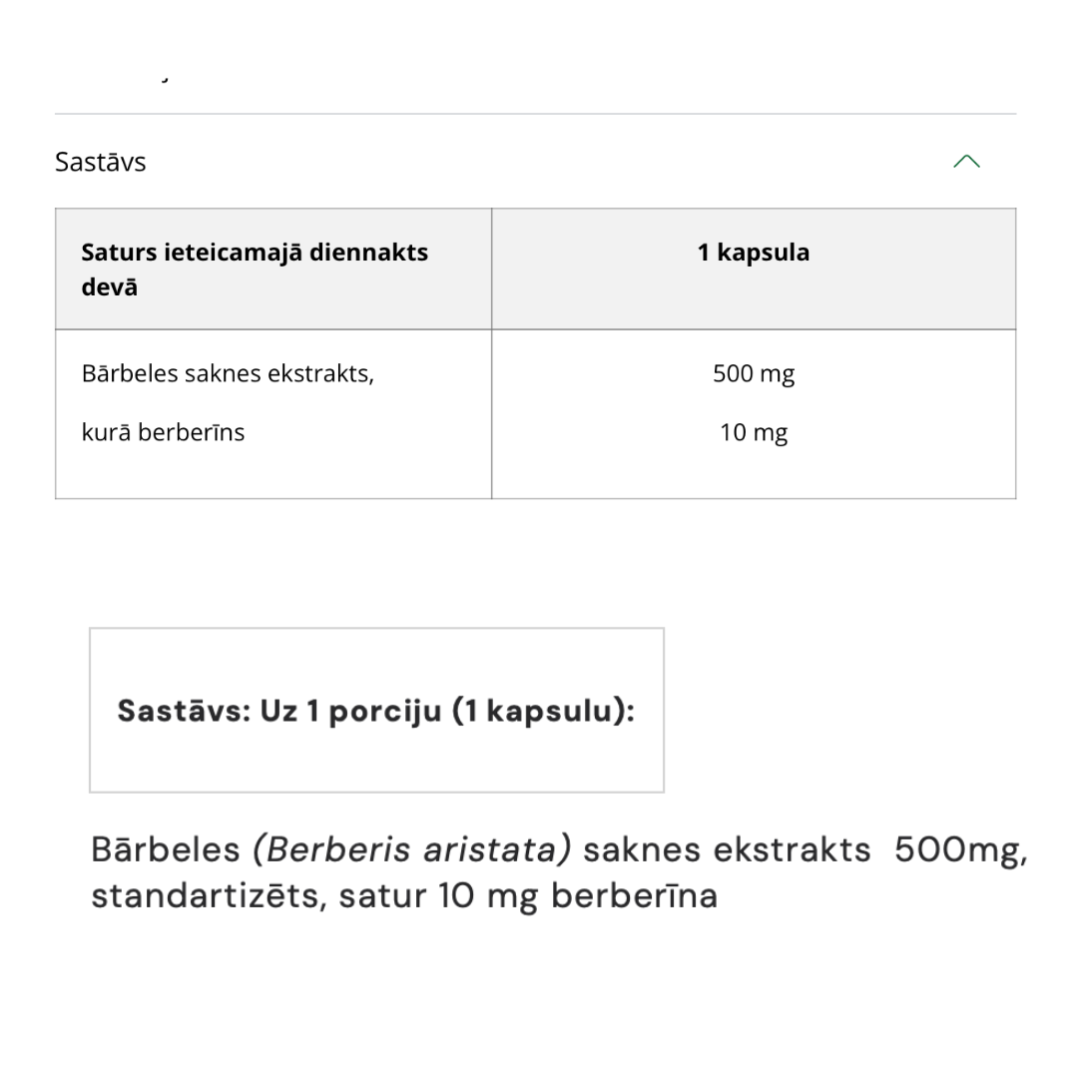
And here is the ugliest part of this whole story, and also of the story of how unregulated the supplement industry is. Because HCL is a concentrate that absorbs well, but there is another form as an extract. The extract usually contains only about 2% of this HCL.
But both are sold and advertised as berberine 500mg. Only one has 500mg of active substance, the other only 2%, i.e. 10mg. So the difference is 50 times.
50 times, Karl!
Which means that the entire package of 90 tablets is one dose, the one used in the studies.
So those who sell this weak 2% product are playing a very dirty game and knowingly lying to their customers, because it is not as if they do not know. They take a much cheaper product, use the 500mg mentioned in the studies, which confuses people, and sell it as an equivalent. They sell empty air. The story is not unique; the same is done with omega-3 and curcumin.
And here is the saddest part of the story: almost all products available for sale in Latvia fall into this category, all of them list 500mg barberry extract with 2% active substance (10mg HCL). And interestingly, they all have identical bottles with identical composition and identical 90-tablet packaging, which raises the suspicion that they are all from one manufacturer. Here is an example:
Prices for these Latvian products range from 5-28 EUR, which only indicates good marketing and shamelessness, because for 20+ EUR you can already get good berberine.
If you have bought one of these products, I would recommend filing a complaint with the seller. Because this product/concentration is not the one that has (even weak and small) studies behind it.
I especially want to call out Lotos Pharma and Fit Factory, who in their berberine descriptions mention studies and their recommendations of 500-1500mg, while at the same time recommending you buy their products, which do not come anywhere near these amounts.
But other negative examples are Ostrovit, Labākais fitnesa kanāls, Silvanols, Lotos pharma, Vitalharmony, Sohi and practically any berberine found in Latvia.
A pretty bad look at the Latvian supplement industry and its methods and ethics, is it not? And Latvia specifically, because elsewhere I do not see such a crazy situation; for example, right next door in Lithuania most products are good and concentrated.
To take berberine or not?
Your decision - but do not expect it to work any miracles. It is not, and does not come close to, Ozempic and other semaglutides, whatever anyone claims.
Especially if your diet is a mess and you consume too many calories daily - there will be no result (on weight).
If you also sort out your diet, are in a calorie deficit, and add physical activity - it might possibly help a little.
If you have health problems and take any medications - definitely consult a doctor before taking berberine.
But if you do buy it, where do I recommend looking for it?
Even if someone in Latvia sells a better one, my faith will be low, because there is another thing about supplements - no one checks whether what they claim is really inside. It may happen that someone does not even have those 2%. I would not be surprised.
I usually recommend choosing iHerb for two reasons - they ship to Latvia and there is at least some trustworthiness, because they carry world-class brands and are not counterfeit (which can happen on, say, AMAZON).
Which products I would recommend based on reviews, composition and brand:
- THORNE - the most expensive, but possibly the best. Yet even this will be several times cheaper than buying even for 5 EUR in Latvia
- NATURAL FACTORS - cheaper, because it is a larger package, but the composition and manufacturer are good
P.S. for full transparency - I get a small commission from iHERB if you buy there with these links (such links exist for everyone registered there, nothing unique; you would have them too if you registered), but I have no interest in making money from it, nor is it a serious thing to pursue.
So I will redirect this income to advertising this post, so that it reaches as many people as possible and they do not get scammed with useless products. I will spend even more on advertising than these commissions.
P.P.S. and you can also help others by sharing this post as widely as possible!
P.P.P.S. if you would like me to help you with nutrition and weight, check out the PROJECTS.